This is my new domain name randylinguitar.com. I’m so happy to have an easy to find name. Look soon for sheet music and CDs. Always more forthcoming from Randy Lin Guitar.
This is my new domain name randylinguitar.com. I’m so happy to have an easy to find name. Look soon for sheet music and CDs. Always more forthcoming from Randy Lin Guitar.
Its a dream business for many of us. My own personal role model for this was the now gone pedal geek.com. Those who remember it well know that it was a haven on the net to browse some boutique pedals you’d never see on the big seller sites.
But to accomplish what pedalgeek did took a lot of work and positioning oneself getting to know suppliers. It’s not something you or I could do overnight.
That leaves most of us with trading pedals we’ve tried but don’t want or need to thin out to pay bills with. Those are our realities. No harm no foul.
There are three or four places to sell your pedals without too much trouble: reverb.com, eBay, mercari, and your local FB market. I find mercari to be the slowest way to sell. Generally, I sell on either reverb.com or local FB. My basic rule of thumb is: $50 and over, sell on reverb. $50 and under sell on local FB. I also prefer to sell anything bigger than a pedal on local market. This will save you a lot on shipping.
As far as pedal shipping cost, you really shouldn’t have to pay more than $7 to $12 to send an average Boss, MXR, EHX, or Keeley size pedal in the lower 48 states. It depends on how you pack it.
I only put bubble wrap on the front of the pedal. The back doesn’t need protection so much as the knobs on the front. Place this in either a bubble envelope from Dollar Tree or a flat rate bubble envelope from the post office and you will be shipping within the $7 to $12 range.
All in all, pedal flipping isn’t really a source of income for me. I meet people and try out some pedals I otherwise wouldn’t get a chance to. If I don’t make a profit off the sale ( bought for $100 sold for $90) I look at it as at least trying out a a$100 pedal for $10 bucks plus shipping.
And that’s that.

We all like to upgrade. We buy one thing, hear the next new thing, and try to buy it. Sometimes we sell off old stuff to get the new stuff. To each accordingly.
But there is wisdom, in fact, practical use, in hanging on to a few pieces of inexpensive equipment, especially if they did no wrong.
For one, they make a great place holder on your board until you find a replacement. But I also like to make an extra rig just to have.
The board in the picture is my mini board. It has everything I need to lay down a song idea or even gig. It’s just an IKEA bamboo cutting board with an overdrive, a multi effects, and a looper, as well as a pick dispenser. This goes into a padded pouch for gigging or onto my bookshelf for when I need it.
I find the effects to be adequate and sometimes even unique. The Ditto Looper can store my ideas until I can transfer them to a recorder or get me thru a looping gig no problem.
So don’t count out your old or cheap effects. They just may be your best pieces of equipment.
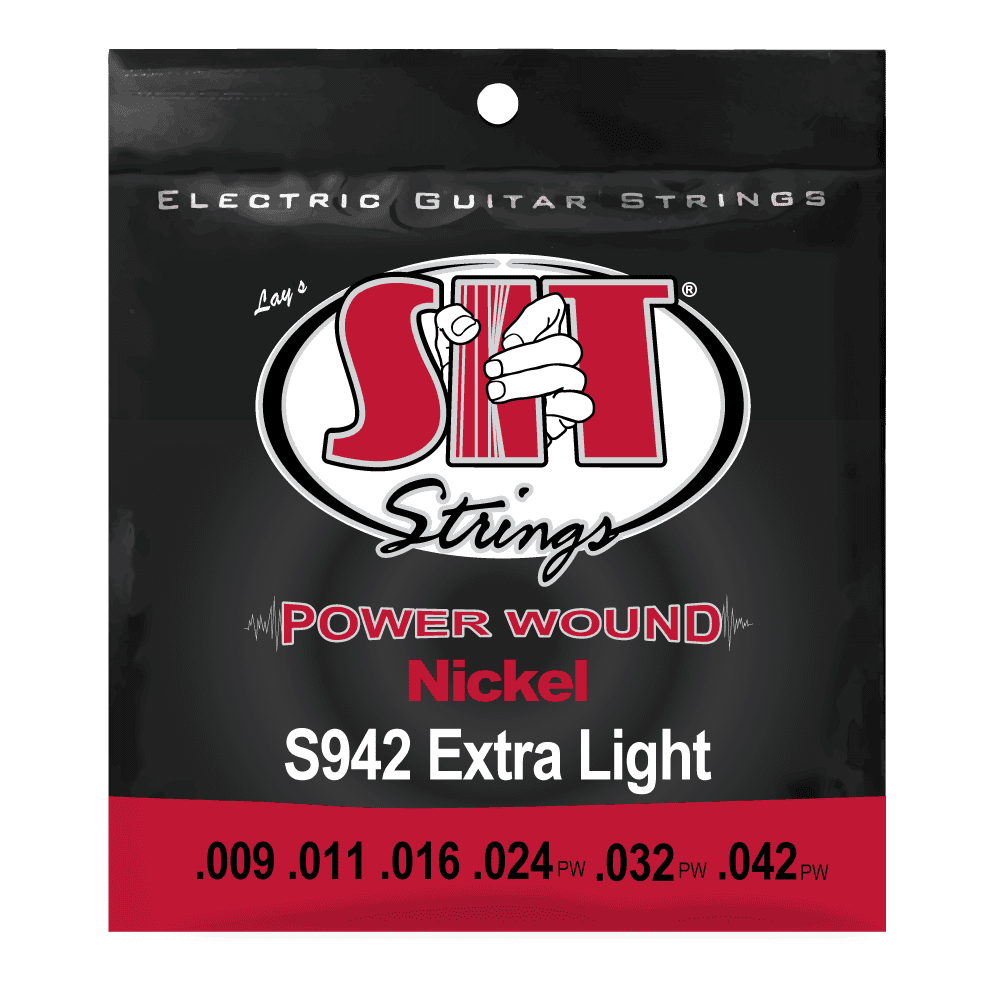 I am very pleased to be partnered with SIT (stay in tune) Strings as an artist endorser. I’ve been using them a long time, and I find they are the best for easy bends and smooth playing, as well as staying in tune like the name on the label says.
Also, they help balance the tremolo springs to strings tension better than any I’ve tried. If you’ve been having trouble floating your bridge, these are the answer.
SIT 9-42 have been my string for years. I hope you’ll give them a try.
With the advent of the home computer, many of us said that it would make musical ability irrelevant. Others said that the computer was just a tool, and new tools are always something cool that musicians will want to work with.
The latter camp proved to be mostly right. People still write songs on instruments as timeless as the guitar and the piano and use the computer to record, edit, and send out their works for their fans.
All good. The jury is still out in my mind about AI music, however. Its a sea change from what was before, some might say the end of what was before. I’m really not sure what to make of it.
A guitar maker who makes things by hand with archaic tools would not be blamed for using a modern skill saw and measuring tools from Home Depot. And though there may be some criticism of computer lathing, it is now an industry standard, and the results have really leveled the quality as to where guitars are made; namely, it doesn’t matter.
But with AI, it seems the tool is now the creator, with very little input from the human operator. That’s my take on it at this time.
I have ventured into using AI as a basic translator for lyrics. The results are a bit plain, but I am able to correct for that using my human knowledge of the language ( Japanese). But the lyrics are mine, not the product of an AI “write this” prompt.
So in a way, I’m “AI guilty”. But i have no plans to automate my music writing. If a usage for it comes up, I want to make sure that its only as a tool. In my opinion, it might be useful in the area of smart midi quantization and velocity editing. I always think the computer really shines as an editor, not a creator.
And that’s that.
When I first moved to Taipei, I was being shuffled around to various A&Rs at the major recording labels. But still I had no contract. Feeling down, I left my agent’s office one day and went for some sushi, which always seems to give me a lift. I had only a week left before having to return to the States and money was running low.
As I left the sushi place, I turned left and saw a small English language school and went in for an interview. They arranged a teaching demo and I got the job the next day. With the day job taken care of, I went down Shin Seng South Road to a small jazz pub called Bluestown. I brought my guitar in and played some Fingerstyle jazz blues for the boss. He put me on the prime spot, Friday at 9:00pm.
After the light jazz show at Bluestown which paid 300NT (about $10 USD), a get you thru the weekend life-saver in those days, I was introduced to a producer. At that time I had a choice: write some sappy love songs for a singer at one of the big labels, or take a chance on something I really love–being a music studio cat. I ditched the diva opportunity and headed over to his studio.
I ended up sleeping in the studio on the floor, borrowing a motorcycle to get to my part-time English job and returning in time for music sessions. One of the cases we got was Hey Song Cola.
After the Hey Song case, my boss had an idea for an album of romantic jazz music that would be released in Kmart in America, sort of a bargain rack item. He asked me to get started on a piece or two.
I went home, grabbed an ovation classical, and played the harmonics you hear at the beginning of Taipei Midnight Bossa. In less than 30 minutes, the song was finished.
Before I could bring the song to the boss, the company broke up and the case was canceled. Luckily, I kept the song in my head. Since I did it in my own free time, I wasn’t going to give it to them anyway^^.
Is Taipei Midnight Bossa original ? Good question. There’s a little bit of Dan Fogelberg’s Guitar Etude #3, but I also borrowed a lot from techniques I developed in my twenties, especially the harmonics. There’s also some Wes Montgomery octaves in there.^^ The sheet music to Taipei Midnight Bossa will be available sometime soon for those who would like to learn the piece. I hope to play this for you all at the next show.
While conscious dynamics are an important part of music, accidental ones such as uneven picking can make you sound less than stellar.
I have spent most of my life playing solid state amps, with the exception of a few great times where I played a nice Marshall or a Fender tube amp. In my experience,most solid state amps don’t accurately represent the envelope of the note you’re playing. There is this “runaway” feel, even on clean settings, that makes you lose confidence in your ability to control their playing, resulting in sometimes overly weak picking.
A good compressor can actually shape the envelope of sound. Every sound has what we call it’s envelope, or in synthesizer terminology, its ADSR ( attack decay sustain release).
Attack is how fast a sound comes in. Guitars, drums, anything percussive has a quick attack. Violins or woodwind instruments come in more slowly, so they have a slower attack.
Decay is how much time an instrument takes to go from it’s initial attack to the main body of the sound. Sustain is how life by the main body lasts, and release is how long the sound fades out.
One should use a compressor to mimic the ideal envelope or ADSR of the sound, but there are exceptions. Some styles of playing require a more flat (squashed) envelope to even out all the notes, while others demand an audibly obvious entry and exit of the compressor (pumping).
I personally like a very subtle compression that clamps down certain frequencies and levels and gives a smooth feeling to the song. For this I use a Boss CS3 compressor. It’s not really obvious, but if you A / B on and off the difference is there.
I run everything thru this compressor, even drum loops. It’s not expensive and it can really help to make your sound more complete.
I used to be against compressors, but they’ve added a lot of value to my pedal board.
And that’s that.
While everyone wants to be excellent at one thing, sometimes we need to branch out and be just pretty good at a lot of things if we want to catch paying gigs.
For instance, being a pretty good transcriber, arranger, band organizer, or being able to play percussion are crucial. Knowing how to conduct a choir, teach your instrument, record an ensemble with minimal equipment are all skills that will come in handy.
I often tell my guitar friends that I prefer an all around guitarist who can use the pentatonic scale well in every genre. This kind of player can handle any chart and make it sound correct.
As far as music reading goes, I think learning to read a jazz chart ( melody with chord symbols) is far more useful than being able to read a full piano score, though I think four part hymn reading is a must.
On the percussion front, if you’re not a drummer, being able to do a variety of grooves on simple hand percussion could get you an accompianment gig at a coffee house or pub.
What I’m trying to say is, being versatile will prepare you for opportunities when they come along. Opportunities unprepared for are opportunities missed.
 randy lin guitar